
Table of Contents
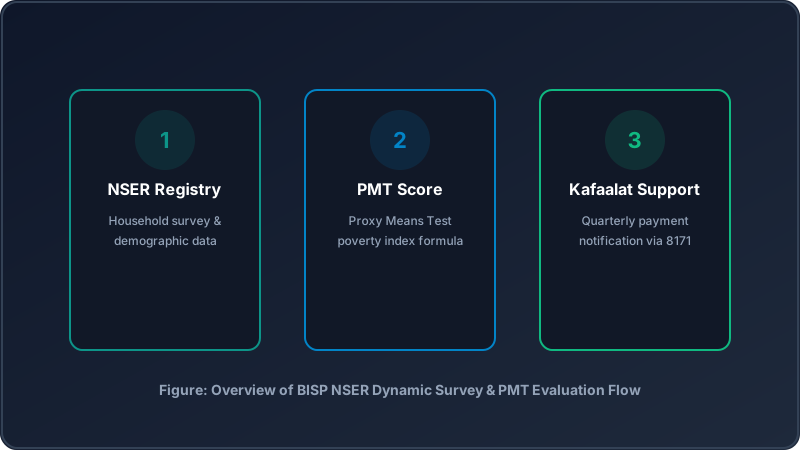
Eligibility for the Benazir Income Support Programme is determined not by subjective political patronage or local recommendation, but through an objective, scientific formula known as the Proxy Means Test (PMT). In this guide, we break down how the National Socio-Economic Registry (NSER) assesses household living standards and how citizens can participate in the dynamic survey.
1. The National Socio-Economic Registry (NSER)
The National Socio-Economic Registry is Pakistan’s central socioeconomic database. Initially populated through nationwide door-to-door paper censuses and subsequent computerized tablet surveys, the NSER has transitioned into a Dynamic Registry model. Under this architecture, permanent registration desks operate within BISP Tehsil offices across all provinces, allowing citizens to self-report demographic changes.
2. Demystifying the Proxy Means Test (PMT) Score
Measuring household income directly in countries with substantial informal economies is notoriously difficult. Many citizens work in agriculture, daily-wage labor, or informal trades without verifiable pay stubs or bank statements.
To solve this, BISP uses a Proxy Means Test (PMT). The PMT algorithm evaluates verifiable household assets, dwelling characteristics, and demographic traits as "proxies" for consumption poverty, computing a numerical score ranging from 0 to 100.
In the PMT scoring system, a lower score reflects greater socioeconomic poverty, while a higher score reflects greater wealth. To qualify for basic Kafaalat support, a household’s PMT score must fall below a threshold set by the Federal Government (historically around 30 to 32, though subject to policy revision).
3. Which Household Indicators Determine the Score?
During the official NSER survey interview, an enumerator records verifiable data regarding:
- Housing Infrastructure: Construction material of the roof and walls (mud/kacha vs reinforced concrete/pakka), source of drinking water, and sanitation facilities.
- Household Demographics: Dependency ratio (number of young children, elderly, and chronically ill relatives compared to working-age adults).
- Productive Assets: Ownership of agricultural land, farm animals, consumer durables (refrigerators, washing machines), and motorized vehicles.
- Education Levels: Literacy and highest completed schooling grade of household members.
4. The Step-by-Step Dynamic Registry Process
- Token Issuance: The female applicant visits the nearest BISP Tehsil Registration Office with her original CNIC and receives an official queue token.
- Data Enumeration: At the survey counter, an authorized BISP data entry officer records household demographics and administers the official NSER questionnaire.
- Biometric Thumbprint: The applicant verifies the information by providing her biometric fingerprint on the digital reader.
- Automated Calculation: The data is transmitted securely to NADRA and BISP central servers where the PMT score is mathematically computed.
- Result Notification: Once processing concludes, an automated SMS notification is issued to the applicant's mobile number strictly from 8171.
5. Common Statutory Disqualification Factors
Under official program integrity guidelines, households are automatically excluded if government database matching reveals:
- Any household member is a regular government or armed forces employee receiving an official pension or salary.
- Any family member owns commercial agricultural land or luxury urban property exceeding programmatic caps.
- Any family member holds an international passport with recorded international air travel history (excluding documented religious pilgrimages like Umrah under special conditions).
- Utility bill averages or executive telecommunication spending exceed poverty thresholds.
Notice: Specific criteria are updated periodically by the Federal Board. Always verify current cutoff benchmarks at 8171.bisp.gov.pk.